Prince William County Public Schools
Using AI to Support Thinking—Not Replace It
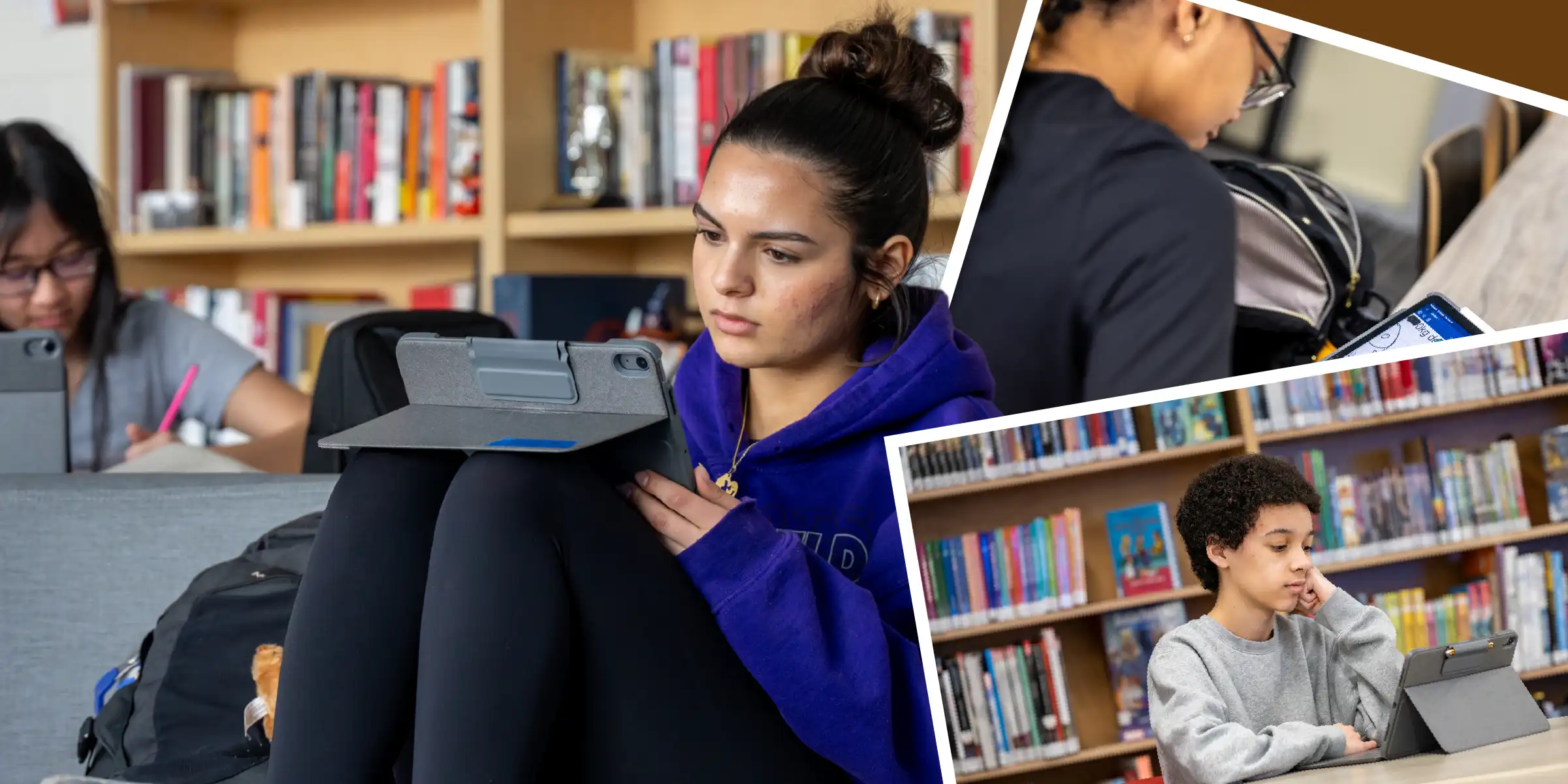 Recently, in the Gainesville High School library, students took part in a lesson exploring how artificial intelligence (AI) can be used as a learning support without replacing student thinking. The lesson, led by school librarians Tripp Ennis and Jackie Krutchen, showed how the library continues to be a place where students think deeply, ask questions, and learn how to use new tools responsibly.
Ennis and Krutchen were clear: AI is not meant to give students answers. Instead, it can help students think more carefully, find better words, and look at topics from different angles.
“We wanted students to understand that their thinking comes first,” Ennis said. “AI should only be used to help build on ideas they already have.”
To reinforce that message, the lesson began without any technology. Students worked together in pairs and small groups to share what they already knew about their topics. They talked through ideas, listened to classmates, and wrote down their thoughts before using any digital tools.
“Starting this way helps students see that learning begins with people, not computers,” Krutchen explained.
Only after students had shared and developed their own ideas did they use Microsoft Copilot. Even then, its use was limited and guided. Students used AI to find stronger vocabulary and generate additional search terms—two areas that can be challenging during research. When students get stuck using the same words repeatedly, it can be hard to move forward. Copilot helped suggest related terms so students could explore their topics more fully.
Many students were surprised to see how similar their own ideas were to the suggestions provided by the tool.
Students were encouraged to be honest about their experience, and some shared that they felt unsure or skeptical about AI. That feedback was welcomed. At the same time, students noticed that using Copilot helped them think more broadly and gave them stronger language for research.
One student shared, “It helped me come up with more search words than I would’ve thought of on my own.”
Throughout the lesson, the librarians reminded students that AI responses should not be taken at face value. Just like websites or articles, AI‑generated information must be checked and questioned, using the same evaluation skills students apply to any source.
“Just because something sounds confident doesn’t mean it’s correct,” Krutchen said. “That’s an important lesson for students to learn.”
Students also reflected on the difference between working with classmates and using AI. Many said AI was faster, but that working with peers felt more meaningful.
“People bring ideas and perspectives that technology can’t,” one student wrote.
Teachers also talked with students about the limits of AI. While it can help organize ideas quickly, it can also narrow thinking if students rely on it too much. That’s why adult guidance and thoughtful use are so important.
To keep the focus on learning, students were not allowed to use AI to find sources or complete research for them. Instead, AI helped bridge the gap between brainstorming and researching. Once students had better words and clearer questions, they moved on to trusted library databases to continue their work.
“The goal is to ask better questions,” Ennis said. “That’s what research has always been about.”
The librarians also talked with students about online safety, reminding them not to share personal information and to ask for help if something feels off.
“Our goal isn’t for students to depend on AI,” Krutchen added. “It’s for them to understand how it works, where it can help, and where it falls short.”
By the end of the lesson, students understood an important message: their ideas matter. Technology can be helpful, but it should never replace curiosity, discussion, or critical thinking. When used carefully and responsibly, AI can be one of many tools that support learning—while keeping students’ curiosity and thinking at the center.