Prince William County Public Schools
Academic Advising
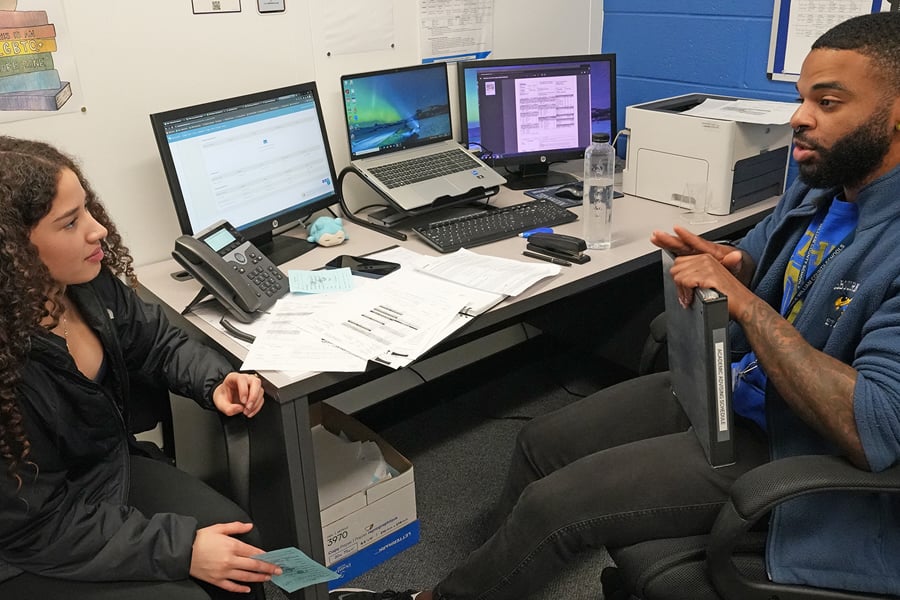
Academic and career vision meetings are held annually for students in grades 5-11 with their school counselors. These individual meetings provide an opportunity for personalized reflection and planning as students prepare for the upcoming academic year and set long-term career goals. The process incorporates multiple elements of college and career readiness to ensure a comprehensive approach to future planning.
Academic & Career Vision Roadmap
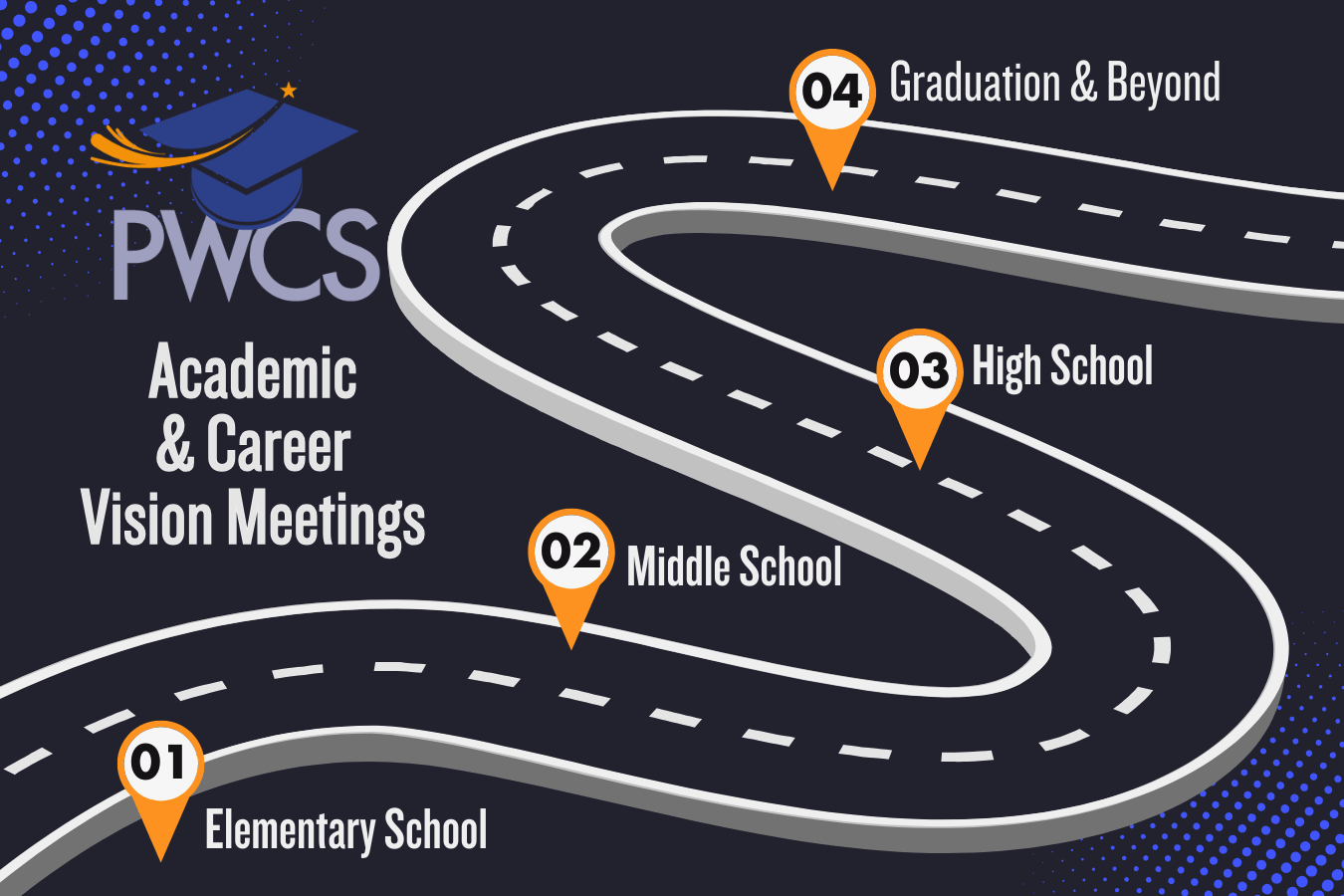
- Elementary: Self Awareness & Career Exploration
- Awareness of self and others, along with personal skills and interests.
- Identifying academic strengths, learning styles, and career interests.
- Middle: Career Development & Future Planning
- Potentially beginning high school coursework in grades 7-8 by taking algebra 1, geometry, and/or world language classes towards high school graduation credit. Any of these courses would begin a student's high school transcript.
- High: Career Experiences & Self-Reflection
- Students seek electives that feed their curiosity and exploration towards future career goals.
- Advanced coursework opportunities.
- Specialty program opportunities.
- Launching: Graduation & Beyond: Applying knowledge, skills, and habits of mind to thrive and contribute to the community
- Accessing post-high school pathways and resources.
Academic & Career Planning Artifacts Include
- Academic Career Plan (ACP) & Academic Career Plan Portfolio (ACPP)
- Elementary (Grades K-5): Virginia Wizard Academic Career Plan Portfolio (PDF)
- Secondary (Grades 6-12): Naviance Academic Career Plan
Academic Advising Components
- Review your academic career plan. Academic and Career Planning (ACP)
- Parent and teacher conversations. Conversation Starters
- Reflect on your vision and post-high school goals. Post-High School Planning
- Review specialty programs and advanced course offerings.
- Review graduation requirements. Graduation Requirement
- Balance commitments, academics, and personal wellness. Social Emotional Learning
Academic Advising Process (6–12)
January
- The process begins with meaningful conversations. Teachers speak with their students at the beginning of January to discuss academic performance and give feedback. Teachers enter student feedback into the student information system, which becomes visible to students in late January.
- Questions: Students and parents/guardians who have questions regarding specific feedback are encouraged to speak with the teacher who provided feedback to gain meaningful insight.
- Preliminary Course Requests in StudentVUE
- Students can review teacher feedback on their course selections and submit course requests through StudentVUE in January. While this step is strongly encouraged, it is not mandatory. The main purpose is to give students and families an opportunity to discuss next year’s goals while considering teacher feedback. If you have questions, please follow up directly with your teacher. Note that students, parents, and guardians cannot delete teacher feedback on course selections. All seven courses and two alternate choices will be finalized with the school counselor.
- View the video on how to enter preliminary course requests into StudentVUE. Click the play arrow at the bottom left of your screen.
February-April
- Students meet individually with their school counselor to discuss course selection, graduation requirements, and postsecondary plans (mid-February–early April), regardless of whether the student enters preliminary course requests in StudentVUE or not.
- This process is facilitated by the school counseling department through specific classes and grade levels.
- Course change requests are reviewed/approved in April based on staffing for the upcoming school year
August
- Student schedules are released in StudentVUE typically on the Wednesday before the first week of the school year.
Student and Family Resources
Resources for all Grade Levels
Grades K–5 Resources
Grades 6–8 Resources
- Review the PWCS Course Catalog and offerings for Advanced Academics and Specialty Programs.
- High school course credit opportunities begin at the middle school level (algebra, geometry, world languages).
- Be aware of Specialty Program Application due dates.
- Check your school webpages or speak to the school counselor for listings on the following:
- Transition to high school nights are offered by middle schools between November–December.
- Rising 9th grade presentations are hosted by high schools in January–February.
Grades 9–12 Resources
- PWCS Ready to Launch – Pacing for Success
- Review the PWCS Course Catalog and offerings for Advanced Academics and Specialty Programs.
- Early College Scholars Program
- Check your school webpages or speak to the school counselor for listings on the following:
- High school-based curriculum information events, unique to courses and programs available at the high school, are typically hosted in November-January.
Additional course offerings:
- Summer Programs
- Virtual Prince William
- Virtual Virginia – Courses are limited, and students can inquire about these potential opportunities with their school counselor in addition to their school-based schedule.
Conversations Starters: How do I/we start preparing?
It is very important that students and parents/guardians take an active role in the selection of courses during high school. Having a family conversation about the student's goals/choices before the student meets with the student's school counselor is key.
- Questions to ask?
- What am I interested in?
- Where do I want to challenge myself?
- What are my future goals?
- For scheduling purposes, each student must select courses totaling seven credits and at least two alternate (backup) electives.
- Students, parents/guardians, and counselors can review course selections and make adjustments if necessary until late April.
- Course selection verification letters will be sent home to students and parents/guardians in late spring.
- The deadline to make course selection changes is set by each high school. This allows administrators to prepare enrollment counts for budget/hiring for the next school year. Classes may be closed/canceled throughout the process due to budget, staffing, and/or low interest.
Review Transfer Program Agreements & College Credit
Review the following:
-
Virginia Community Colleges' statewide transfer programs and agreements and the benefits of high school dual enrollment.
-
College and Career Ready Virginia (CCRV) is an initiative that expands access to dual enrollment courses for high school juniors and seniors. Eligible students earn college credits at no tuition cost* through a partnership between Prince William County Public Schools (PWCS) and Northern Virginia Community College (NOVA).
-
PWCS offers many dual enrollment opportunities that let you earn high school and college credit at the same time. You can explore the available courses, requirements, and how to get started on our website.
-
College admission requirements: Four years of English, math, science, and social studies; and world language requirements for advanced coursework
-
Transfer Virginia provides a database for students to search transferable opportunities.
-
How to have college credits evaluated at the collegiate level:
Obtain official documentation once students have selected their institution, accepted the offer of admission, and received a student ID number.
-
Dual Enrollment (DE): Student requests Northern Virginia Community Collegeto send the transcript to the accepted college for evaluation. The four-year college will need to review the college transcript for potential credit. Transfer Virginia is also an opportunity to review transfer credit.
-
Advanced Placement (AP): Request that the College Board send an official AP score report to the college to receive college credit or placement.
-
Students may send scores for free to one recipient every year they take AP exams and any additional scores for a fee.
-
College credit varies by institution and can be researched on their website, typically found on the school registrar's site
-
- International Baccalaureate (IB)
- Cambridge Programme (AICE)
Understand college policies:
- Each college has its own transfer credit policy, including:
- Minimum grade requirements (e.g., C or higher).
- Limits on the number of transferable credits.
- Whether credits apply toward degree requirements or only as electives.
- Check for Articulation Agreements:
- If transferring from a community college or within the same state system, look for articulation agreements or statewide transfer guides (e.g., Virginia’s UCGS/Passport program).
- Follow Up:
- After submission, monitor your student portal or contact the registrar to confirm evaluation status.
- Ask for a transfer credit report showing which courses were accepted and how they apply to your degree.
Frequently Asked Questions
Can I take any class I want?
-
Refer to the PWCS Course Catalog and talk with your counselor and teachers to find out about course requirements, prerequisites, and sequencing. You need to comply with the course prerequisites specified in the PWCS High School Course Catalog. (Example: English 9 must be completed before English 10.)
-
Note: Some AP and advanced classes have summer reading or assignments.
How many classes must I choose?
-
Students must choose courses totaling seven credits and provide two alternate (backup) electives. If your requested course(s) are not available, alternative course(s) will be inserted into your schedule.
- To maintain eligibility for sports and VHSL-sanctioned activities, students must take and pass a minimum of five courses for credit, and two of the five passing grades must be “C” or higher.
- Courses previously passed and being retaken for a higher grade do not count towards eligibility. Classes previously failed and are being retaken do count towards eligibility.
- To maintain eligibility for sports and VHSL-sanctioned activities, students must take and pass a minimum of five courses for credit, and two of the five passing grades must be “C” or higher.
- Rising seniors requesting a reduced course load (early release/late arrival) must obtain the necessary paperwork from the school counselor. Students must select seven courses and seven classes and at least two alternates during academic advising and course selections will be adjusted if the request for a reduced schedule is approved.
Can I change my schedule in the summer or next year?
- Each high school sets its own schoolwide schedule change procedures and guidelines. Students must comply with the schedule change process established at their school. Read more regarding schedule changes.
- Teaching schedules for each school are developed based on graduation requirements, course requests, and staffing. Budget and conflicts within individual schedules could impact a course available. Students are encouraged to prepare and have meaningful conversations with teachers, families, and counselors in the spring.
- If a requested course is not offered or conflicts with a course that is required for graduation, one of the student's course alternates will be used.
When are student schedules released?
PWCS typically releases student schedules via ParentVUE and StudentVUE the Wednesday before the first day of school. Parents/guardians are encouraged to have ParentVUE accounts set up prior to that time. This is an excellent way to monitor student grades, attendance, and other information from PWCS.