Prince William County Public Schools
Social Emotional Learning
Social and Emotional Learning (SEL) is the process through which children and adults understand and manage emotions, set and achieve personal and collective goals, feel and show empathy for others, establish and maintain positive relationships, and make responsible decisions.
SEL in PWCS
Our Philosophy
PWCS believes SEL is a fundamental part of education and human development. We are dedicated to creating a school division in which SEL is embedded in our educational practices and providing opportunities to enhance skills among our students, families, and staff.
We support the Virginia Department of Education's vision and mission:
"The vision of social emotional learning in Virginia is to maximize the potential of all students and staff to become responsible, caring and reflective members of our diverse society by advancing equity, uplifting student voice, and infusing SEL into every part of the school experience."
What We Do
PWCS implements a divisionwide program providing resources and support to create opportunities for both implicit and explicit social-emotional learning. Each school has a designated SEL Coach dedicated to doing the following:
- Assist in incorporating SEL standards into school practices and curriculum.
- Assist in building staff capacity to meet their own and students' social and emotional needs.
- Guide educators in developing and enhancing existing practices and tools to increase students' fundamental emotional and social competencies.
- Assist in the implementation of schoolwide programming to support a positive climate and culture for both staff and students.
PWCS Skills Wheel
The Virginia Department of Education created SEL Guidance Standards that include many important skills across five competencies: Self-Awareness, Self-Management, Social Awareness, Relationship Skills, and Responsible Decision-Making.
Research suggests that students benefit most when schools focus deeply on a smaller set of high-impact skills rather than trying to teach all SEL skills with equal emphasis at the same time.
High-leverage skills align directly with the five competencies:
- Emotional Awareness
- Self-Regulation
- Empathy and Perspective Taking
- Communication and Conflict Resolution
- Goal Setting and Academic Perseverance
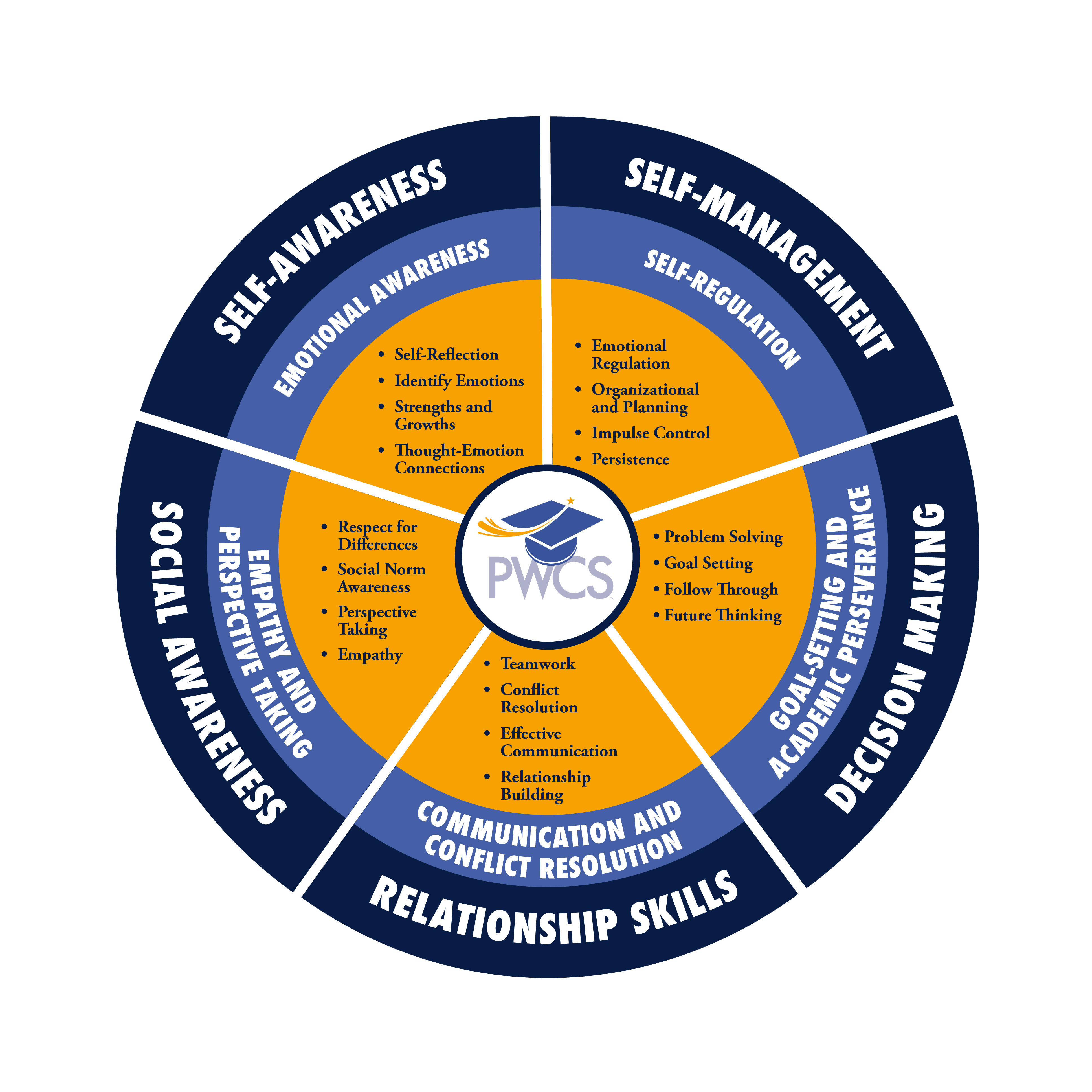
The Skills Wheel highlights 20 key, measurable skills that are also assessed through the SEL Snapshot (SELS). This framework emphasizes a developmental progression as shown in the chart below. This helps educators focus on the skills students need most at each age of development to improve behavior, engagement, academic success, and readiness for life beyond graduation.
Focus Areas by Grade Level
-
K–5Foundational Skills
- Recognizing emotions
- Self-regulation
- Early goal setting
-
6–8Relational Skills
- Understanding others' perspectives
- Building healthy relationships
- Communication skills
-
9–12Advanced Application
- Making responsible decisions
- Ethical reasoning
- Self-direction and future planning
Explore the five core SEL competencies
Self-Awareness
The ability to understand one's own emotions, thoughts, and values and how they influence behavior across contexts.
This includes recognizing emotions, understanding connections between thoughts and feelings, and developing an accurate sense of self.
Skills look like:
- Identifying and naming emotions accurately.
- Recognizing personal strengths and areas for growth.
- Connecting thoughts, feelings, and behaviors.
- Reflecting on experiences and personal responses.
- Understanding how emotions influence decision-making.
- Demonstrating confidence while remaining open to feedback.
Self-Management
The ability to manage one’s emotions, thoughts, and behaviors effectively in different situations and to achieve goals and aspirations.
This includes emotional regulation, organization, impulse control, persistence, and self-reflection.
Skills look like:
- Managing emotions during challenges or setbacks.
- Demonstrating impulse control and responsible behavior.
- Staying organized and planning ahead.
- Persisting through difficulties and obstacles.
- Reflecting on personal actions and adjusting as needed.
- Demonstrating self-discipline to meet expectations and goals.
Social-Awareness

The ability to understand and empathize with the perspectives of others, including those from diverse backgrounds, cultures, and contexts.
This includes empathy, perspective taking, awareness of differences, and understanding social expectations.
Skills look like:
- Demonstrating empathy towards others.
- Considering different perspectives before responding.
- Respecting individual and cultural differences.
- Recognizing how actions affect others.
- Understanding and responding appropriately to social norms.
- Valuing diverse experiences and viewpoints.
Relationship Skills
The ability to establish and maintain healthy and supportive relationships and to effectively navigate settings with diverse individuals and groups.
This includes the capacities to communicate clearly, listen actively, cooperate, work collaboratively to problem-solve and negotiate conflict constructively, navigate settings with differing social and cultural demands and opportunities, provide leadership, and seek or offer help when needed.
Skills look like:
- Working collaboratively with others.
- Communicating ideas clearly and respectfully.
- Building positive relationships with peers and adults.
- Resolving conflicts constructively.
- Demonstrating reliability and trustworthiness within a group.
- Seeking and offering support when needed.
Decision-Making Skills
The ability to make caring and constructive choices about personal behavior and social interactions across diverse situations.
This includes problem-solving, future thinking, goal setting, and following through on commitments.
Skills look like:
- Setting meaningful short- and long-term goals.
- Identifying possible solutions to challenges.
- Evaluating consequences before acting.
- Considering future outcomes when making decisions.
- Following through on commitments and responsibilities.
- Applying problem-solving strategies in academic and social situations.
Responsible Decision-Making Social-Emotional Learning Video (PBS)
Resources for Families
Parents and caregivers are students' earliest teachers and are essential in promoting and supporting SEL. Here you will find resources and tools on how to foster growth and development within your home as well as how to partner with schools to help shape implementation efforts.
Harmony SEL Remote Learning Support for Educators and Families
Online toolkit to help parents and caregivers practice social and emotional skills with students in grades preschool-6.
ParenTeen Connect
ParenTeen Connect is a place where parents and teens can communicate, connect, and break through on tough topics.
PBS SEL @ Home
Videos and resources for families to use to introduce, enhance, and supplement SEL at home.
Sesame Street Family Resources
Resources to help children and families navigate everyday challenges.
Six Seconds
Insight and advice for parents and caregivers on creating an emotionally intelligent family. Also includes a few articles for kids.
VDOE Social-Emotional Wellness Video Quick Guides
Quick videos surrounding multiple topics on social-emotional wellness.
Whole Child, Whole Family Health
Alliance for a Healthier Generation provides ideas and tips for families to get healthy physically and mentally.
Contact Us
-
Heather Wines
Supervisor, Social Emotional Learning -
Vonne Thomas
Administrative Coordinator